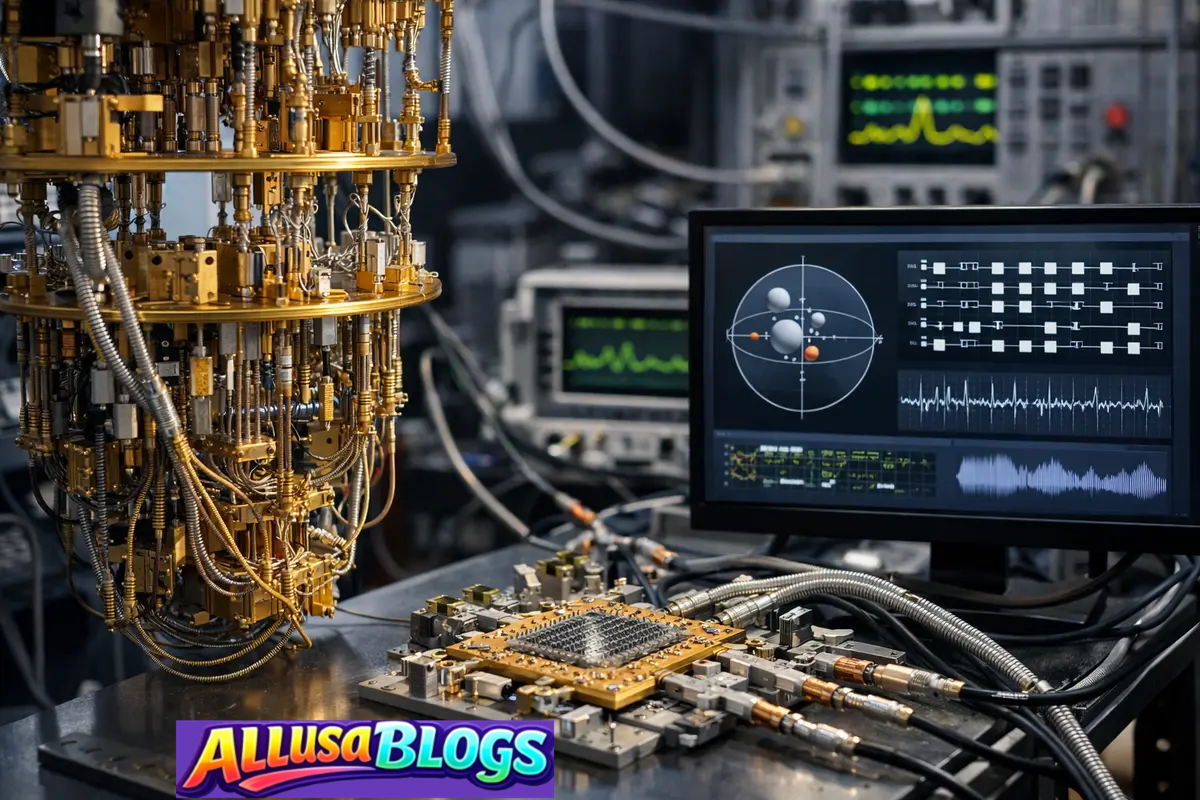
Introduction to S-NISQ Quantum Error Correction
The rise of S-NISQ Quantum Error Correction has unlocked possibilities that were once considered purely theoretical. However, the journey toward stable and scalable quantum systems is still filled with challenges—especially when it comes to handling errors. This is where S-NISQ quantum error correction enters the spotlight. Designed specifically for the current generation of noisy quantum devices, this approach is transforming how researchers manage instability in quantum computations.
S-NISQ quantum error correction builds upon the principles of Quantum Error Correction while adapting them for practical, near-term quantum machines. Unlike traditional methods that require large numbers of qubits, S-NISQ techniques are optimized for systems with limited resources, making them highly relevant in today’s quantum landscape.
Understanding the NISQ Era and Its Challenges
Before diving deeper, it’s important to understand the concept of the NISQ era. NISQ stands for Noisy Intermediate-Scale Quantum, a term introduced by John Preskill. It refers to the current stage of quantum computing where devices have dozens to hundreds of qubits but are still prone to noise and errors.
These quantum systems suffer from decoherence, gate imperfections, and environmental interference. As a result, even simple calculations can produce unreliable outputs. Traditional error correction methods, which rely on redundancy and large-scale qubit encoding, are often impractical in this environment. This gap is exactly what S-NISQ quantum error correction aims to fill.
What Makes S-NISQ Quantum Error Correction Unique
S-NISQ quantum error correction is tailored for efficiency. Instead of requiring massive overhead, it focuses on lightweight error mitigation strategies that work within the constraints of existing hardware. This makes it a bridge between theoretical quantum computing and real-world implementation.
One of its defining features is its hybrid approach. It often combines classical post-processing with quantum operations to reduce errors. This synergy allows researchers to improve accuracy without dramatically increasing system complexity. In essence, S-NISQ quantum error correction is less about eliminating errors entirely and more about managing them intelligently.
Core Principles Behind S-NISQ Quantum Error Correction
At its core, S-NISQ quantum error correction relies on several innovative principles. These include error mitigation, probabilistic correction, and adaptive algorithms. Instead of encoding a single logical qubit into many physical qubits, it leverages statistical techniques to estimate and reduce errors.
Another key principle is circuit optimization. By simplifying quantum circuits and reducing gate depth, S-NISQ methods minimize the chances of error accumulation. Additionally, noise characterization plays a crucial role, allowing systems to identify and compensate for specific types of interference.
Key Techniques Used in S-NISQ Quantum Error Correction
Several techniques define the effectiveness of S-NISQ quantum error correction. One widely used method is zero-noise extrapolation, where computations are performed at different noise levels and then extrapolated to estimate a noise-free result. This approach is particularly useful in current quantum processors.
Another important technique is probabilistic error cancellation. This method uses knowledge of noise models to reverse the effects of errors mathematically. While computationally intensive, it provides a powerful way to enhance accuracy without additional qubits.
Additionally, measurement error mitigation helps correct inaccuracies that occur during the readout process. By calibrating measurement systems, researchers can significantly improve the reliability of results.
Benefits of S-NISQ Quantum Error Correction
The advantages of S-NISQ Quantum Error Correction are substantial. First and foremost, it enables meaningful computations on today’s quantum devices. Without it, most quantum results would be too noisy to be useful.
Another major benefit is scalability. Since S-NISQ methods require fewer resources, they can be implemented across a wide range of quantum platforms. This flexibility makes them ideal for both academic research and industrial applications.
Furthermore, S-NISQ quantum error correction accelerates innovation. By making quantum systems more reliable, it allows researchers to experiment with complex algorithms and explore new use cases without waiting for fully fault-tolerant quantum computers.
Real-World Applications and Use Cases
S-NISQ quantum error correction is already making an impact across multiple industries. In chemistry, it is being used to simulate molecular interactions with greater accuracy. This has significant implications for drug discovery and material science.
In finance, quantum algorithms enhanced by S-NISQ techniques are being explored for portfolio optimization and risk analysis. These applications require high precision, making error correction essential.
Additionally, optimization problems in logistics and supply chain management are benefiting from improved quantum reliability. By reducing computational errors, S-NISQ quantum error correction helps deliver actionable insights in real-world scenarios.
Limitations and Current Challenges
Despite its advantages, S-NISQ quantum error correction is not without limitations. One of the main challenges is its dependence on accurate noise models. If the noise characterization is incorrect, the error mitigation process may produce misleading results.
Another limitation is computational overhead. Some techniques, such as probabilistic error cancellation, require significant classical processing power. This can offset some of the performance gains achieved through quantum computation.
Moreover, S-NISQ methods do not provide full fault tolerance. They are a temporary solution designed for the current generation of quantum devices. As systems evolve, more robust error correction methods will be needed.
Future of S-NISQ Quantum Error Correction
The future of S-NISQ quantum error correction looks promising. As quantum hardware continues to improve, these techniques will become even more effective. Researchers are actively developing new algorithms and optimization strategies to enhance performance.
In the long term, S-NISQ quantum error correction is expected to play a crucial role in the transition to fault-tolerant quantum computing. It serves as a testing ground for ideas that will eventually be integrated into more advanced systems.
Collaboration between academia and industry is also driving progress. Leading organizations and research institutions are investing heavily in this field, ensuring rapid advancements in both theory and practice.
Why S-NISQ Quantum Error Correction Matters Today
In today’s quantum computing landscape, S-NISQ quantum error correction is not just an option—it is a necessity. Without it, the potential of quantum systems would remain largely untapped. By addressing the limitations of current hardware, it enables practical applications and meaningful results.
This approach also democratizes quantum computing. By reducing the need for large-scale infrastructure, it allows more researchers and organizations to participate in the quantum revolution. This inclusivity is essential for accelerating innovation and discovery.
Conclusion
S-NISQ quantum error correction represents a critical step forward in the evolution of quantum computing. By adapting traditional error correction methods to the realities of the NISQ era, it provides a practical solution to one of the field’s biggest challenges.
While it is not a permanent replacement for full fault-tolerant systems, its impact is undeniable. From improving computational accuracy to enabling real-world applications, S-NISQ quantum error correction is driving the next generation of quantum innovation.
As the field continues to evolve, this approach will remain at the forefront of research and development. For anyone interested in the future of quantum technology, understanding S-NISQ quantum error correction is essential.